- By :
- Comments: 0
homestay with local experience Alappuzha
homestay with local experience Alappuzha
Last Updated: August 13, 2026
Quick Answer: homestay with local experience Alappuzha
- A homestay with local experience in Alappuzha means eating what we eat, living on the water, and slowing down to island time — not tour time.
- Ask for the morning boat to Punnamada at 7:15 AM — it’s the one that carries the fishermen, and the market smell hits you before the shore does.
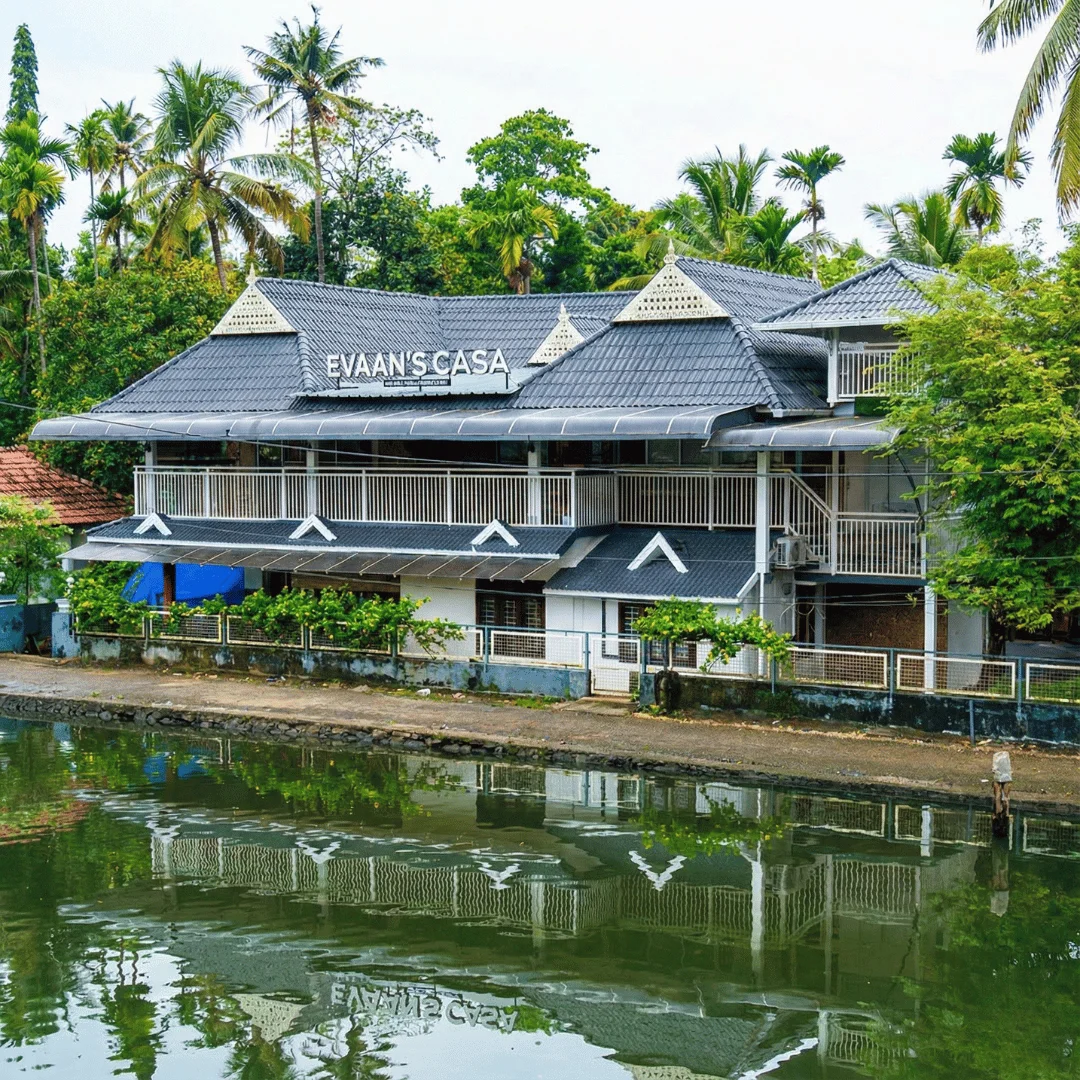
- Evaan’s Casa fits because there’s no road to our door; the food comes from our kitchen, and the lake is your front yard.
The first thing guests notice isn’t the view, though the view is good. It’s the silence. That deep, complete absence of engines and horns. Just the water lapping against the wooden posts of the veranda, and somewhere far off, a kingfisher rattling its call. I’ve seen people stand at the railing for five full minutes before they say a word. They’re listening, or maybe they’re just letting the quiet wash over them.
We’re on a small island in Vembanad Lake, about six minutes by boat from the Alappuzha mainland. No road access. That’s the whole point. You leave your car, your worries, your phone alerts on the shore, and you come across with me in the vallam. The diesel hum of that boat is the last mechanical noise you’ll hear until you leave.
And then there’s the food. Honestly, I think that’s what people remember most. Not the sunset, not the birds, but the meals. Because food here isn’t a performance. It’s just how we live — and we’ve opened the door so you can live that way too, even for a few days.
What food can you expect at homestay with local experience Alappuzha?
Home-style Kerala food. That’s the honest answer. Not restaurant-style, not fusion, not plated with tweezers. It’s the food from the homestay kitchen, cooked the way the backwater households have cooked for generations. Rice, fish, coconut, and spices. That’s the whole universe, really.
Look, here’s the thing. When you stay on an island with no shops around, the kitchen works with what the lake and the paddy fields give us. That means the fish was probably swimming this morning. The coconut was grated within the hour. The banana leaves under your food came from the tree by the well. You taste that freshness even if you can’t name it.
I’m probably biased, but the karimeen from our lake is the best in the state. Pearl spot, they call it in English. It’s a muddy-flavoured fish that some people find strange at first, but give it one chance, and you’ll understand. We marinate it in a paste of red chillies, turmeric, ginger, and garlic, wrap it in banana leaf, and steam it over a low fire. The leaf chars a little, the fish stays moist, and the smell — woodsmoke and citrus and spice — that’s the smell of an Alappuzha afternoon.
What you won’t find here is a buffet with fifty items. No pasta, no pizza, no continental breakfast spread. That’s not a weakness. It’s a promise that what you get, we make properly. Rice, sambar, thoran, fish curry, maybe a roast chicken on some days. Simple, but honest.
What does a typical meal look like here?
A meal here is served on a banana leaf, and there’s a rhythm to it. The rice goes in the middle. Then the curries circle around it. You eat with your right hand, mixing everything, feeling the textures. Most guests try it that way, some struggle, and that’s okay. There’s no judgment. A spoon appears if you ask.
The lunch spread usually has a couple of vegetable dishes — thoran, which is finely chopped cabbage or beans sautéed with coconut and mustard seeds in coconut oil, and a curry, maybe avial with its thick yogurt-coconut gravy. There’s always sambar, the lentil stew with drumsticks and tamarind. And there’s the fish, either the pollichathu or a simple fish curry with raw mango, the kind that’s better on day two but never lasts that long here.
The mustard seeds crackle in hot coconut oil at the start of every dish. That’s the sound of our kitchen. You’ll hear it from the veranda around noon, that sharp, rhythmic pop, and you’ll know lunch is close. Rain on the tin roof often joins in, because the monsoon hits us hard from June to August, and there’s nothing better than that sound while you’re eating something warm.
Dinner is lighter. A kappa (tapioca) and fish curry night, or a simple vegetable stew with appam. The appam is lacy at the edges and soft in the middle, best eaten straight off the pan. Some guests disagree with the idea of eating with their hands. That’s fair. But I’ll say this — food tastes different when you touch it.
Here’s a small table of what you might see, and what’s actually in it:
| Dish | What’s in it |
|---|---|
| Karimeen Pollichathu | Pearl spot fish, red chilli, turmeric, ginger, garlic, banana leaf, slow steam |
| Thoran | Finely chopped beans or cabbage, grated coconut, mustard seeds, coconut oil |
| Avial | Mixed vegetables, yogurt, coconut paste, curry leaves |
| Fish Curry (Meen Curry) | Fresh lake fish, raw mango, red chillies, kokum or tamarind, coconut milk |
| Appam with Stew | Fermented rice flour pancakes, vegetable or chicken stew in coconut milk |
What’s breakfast like on the island?
Breakfast is when you really feel the pace of island life. You sit on the veranda, the lake directly in front of you, and the tea comes first. Strong, milky, sweet enough to get you moving. Then the food arrives, and it’s never heavy. Puttu with kadala curry is the classic — steamed cylinders of rice flour and coconut, paired with a dark, rich chickpea curry. You break the puttu apart, press it into the curry, and eat it hot.
Or idiyappam, those delicate nests of rice noodles, served with a mild egg curry or just some sweetened coconut milk and banana. Some mornings we do dosa, crisp and golden, with a coconut chutney that has a tiny hit of green chilli. Most people skip breakfast at their usual hotels, but here, you’d be missing the best part of the day.
The tea comes from a small shop on the mainland. We’ve been getting it from the same family for years. The milk comes from a neighbour who has three cows and a very bossy rooster. It’s not an artisanal, single-origin thing. It’s just everyday life, and that’s what makes it special.
If you’re the type who needs WiFi with breakfast, I’ll be honest — we have it, but it’s slow. It works for messages, not for streaming. Most guests discover they don’t mind. The herons on the paddy field edge are better entertainment than anything on a screen.
Frequently Asked Questions About homestay with local experience Alappuzha
How far is the homestay from the Alappuzha town centre?
The boat ride is roughly six minutes from our jetty on the mainland. You’ll park at a small, safe spot near the jetty, and I’ll be there to pick you up. It’s a short hop across the water, and honestly, that little ride is part of the charm. You arrive on the island like you’re entering another world.
Is it safe to stay on an island with kids?
Yes, very safe. There are no cars, no roads, no strangers wandering by. The water is right there, so keep an eye on little ones near the edge, but the veranda is gated and the lake is shallow near the steps. Kids love the boat ride and the freedom to roam the small paths around the property.
What should I bring for a comfortable stay?
Insect repellent, for sure, and a pair of sandals you don’t mind getting wet. The mosquitoes come out at dusk, but the nets on the beds are solid. Bring a book, maybe two. And bring an open mind about food — some things will be new, and that’s the point.
How much does it cost to stay here?
Rates vary by season, but they’re honest for what you get. The price includes your room, all your meals, and the boat transfer. No hidden charges. No extras for the lake view, because every room has one. Best to check the current rates on the Evaan’s Casa website.
Look, I’ve been on this island my whole life. I know every channel, every fishing spot, every family that lives along the banks. When I opened the homestay, I didn’t want to build a resort. I wanted to share this life — the slow mornings, the sound of rain, the smell of coconut oil and fresh curry leaves. The food is the heart of that. It’s not a show. It’s just how we eat, and you’re welcome to sit at our table.
Some guests come for one night and stay for three. Others come for a week and leave as friends. That’s how it works here. You don’t book a room; you book a seat at a table that happens to float on the lake.
If you’re looking for a homestay with local experience in Alappuzha, you’ll find the water, the palms, and the quiet. But the food is what you’ll carry home. The taste of that first karimeen, the warmth of a banana leaf under your hands, the steam rising off the rice. That’s the comfort of staying here. That’s the island, served on a plate.
Come hungry. Leave full. And maybe, like most guests, a little slower than you arrived. That’s the whole point of this place. The Evaan’s Casa door is open, and the tea is almost ready.
Plan your stay at Evaan’s Casa
- Lake view homestay in Alleppey (Alappuzha)
- Where to stay in Alleppey: the complete guide
- Alleppey room booking: rooms and prices from ₹1,900
- Budget homestay in Alleppey under ₹2,000
- Backwater homestay on Vembanad Lake
- Punnamada homestay, Alappuzha
- Family homestay in Alleppey
- Honeymoon package and couple stay
Book direct on WhatsApp +91 88484 96667