- By :
- Comments: 0
best homestay like Evaans Casa
best homestay like Evaans Casa
Last Updated: August 30, 2026
Quick Answer: best homestay like Evaans Casa
- The best homestay like Evaan’s Casa is one that sits alone on the water, ringed by paddy and palm, reachable only by boat.
- Ask for the 6:15 AM ferry from the mainland jetty — it’s the quietest crossing, and you’ll see the lake before the day boats churn it up.
- Evaan’s Casa fits because it gives you that island silence, with nothing but the Vembanad Lake and the villages breathing around you.
The mist sits low on the lake at dawn, grey and soft like unwashed cotton. The first diesel engine coughs awake somewhere across the water — a vallam boat, probably, carrying fish or coconuts to the mainland. Woodsmoke drifts from a village kitchen on the far shore, and I smell it before I see anything else. That’s the morning here. That’s how it starts.
I’m Jackson. I grew up on these backwaters, and I run this island homestay with my own hands. No road reaches us. You come by boat, six minutes from the jetty, and the world changes in that short crossing. The noise drops away. The air turns wet and green. By the time you step onto our wooden jetty, you’re already somewhere else.
What can you see from best homestay like Evaans Casa?
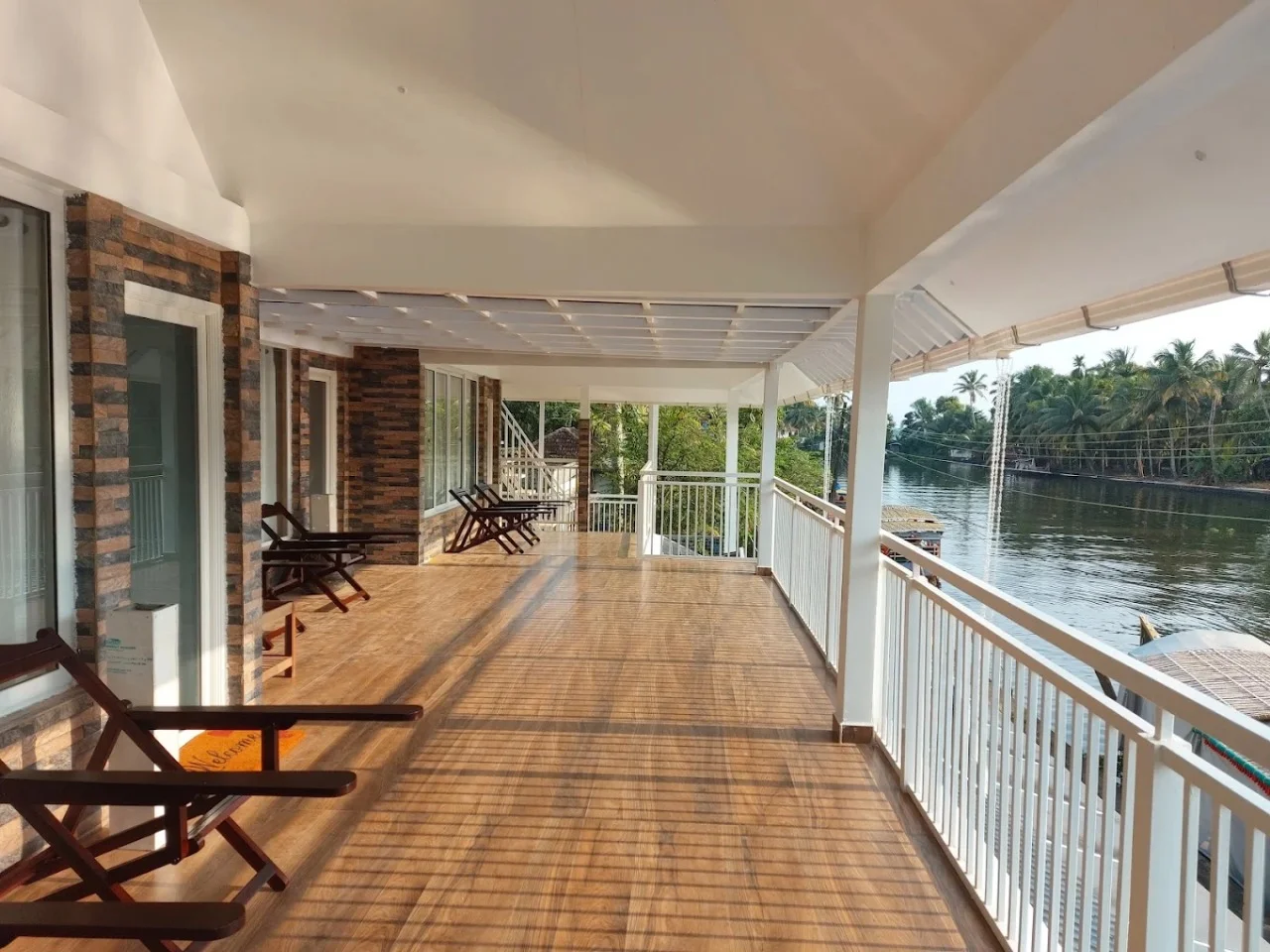
From the veranda, the lake spreads out like a living thing. It’s not flat — it breathes, shifts, catches the light in a hundred different greys and greens. Paddy fields hug the shoreline, low and luminous, and when the wind moves through them, the whole island seems to sway.
Look left and you’ll see coconut palms leaning over the water, their reflections broken by ripples. Look right, and there’s a fishing boat threading through the channels. Cormorants dry their wings on a bamboo post. A kingfisher sits, waits, then drops like a stone.
The rooms face the water too. You wake up and the lake is right there, framed by the window, no glass between you and it. Just air and light and the occasional call of a bird. Fans and mosquito nets keep things simple. Hot water comes when you need it. The veranda is the real room, honestly — that’s where guests spend their time, watching the day pass on the water.
What’s around the island once you’re there?
The island is small, but it’s not lonely. A ten-minute walk along the bund brings you to the neighbouring village, where the houses are painted in faded blues and pinks, and the women wash clothes on stone steps by the canal. The local shop sells tea in small glasses, and if you sit there long enough, someone will tell you where the good fish is that day.
Most people skip this, but the paddy fields are the heart of it. In the growing season, the fields are a deep, almost impossible green. During harvest, the air fills with the smell of cut straw, and the threshing sounds carry across the water like drumbeats. The farmers let us walk the bunds, and guests often come back with mud on their shoes and a story to tell.
There’s a small temple on the next island over, maybe twenty minutes by boat. On festival days, you can hear the drums from our veranda, a low pulse that travels across the water. The boatman will take you there for a few hundred rupees. He knows everyone, and everyone knows him.
Can you walk or explore the area nearby?
You can walk a good deal, yes. The island has paths that loop through the coconut groves and along the water’s edge. It’s not a long walk — maybe an hour if you take your time — but it’s a walk through a life that hasn’t changed much in decades. You’ll see men mending nets, children shouting on their way to school, a goat tied to a palm.
For longer trips, the boat is your legs. The village of Kainakary is close, and it has a market on Tuesdays and Fridays that’s worth the ride. The boatman will wait for you, or you can come back on the public ferry — it runs every hour or so, and the locals will point you the right way. The diesel hum, the slap of water against the hull, the way the light falls through the palm leaves — that’s part of the experience too.
Some guests rent a canoe and paddle through the narrow channels by themselves. The water is calm, and the channels are marked well enough. You’ll pass other islands, see the same paddy fields from a different angle, find yourself in a part of the backwaters that most tourists never reach. I’m probably biased, but I think that’s the best way to see it.
The food here is home-style Kerala, prepared at the homestay with whatever the lake and the land give us that day. Fish from the morning catch, vegetables from the nearby farms, rice from the fields you can see from your window. Mustard seeds crackle in coconut oil, and the smell of it drifts through the house at mealtime. You eat on the veranda, if you like, with the lake at your feet.
Look, here’s the thing. A best homestay like Evaan’s Casa isn’t about luxury. It’s not about marble floors or air conditioning or a spa. It’s about being in a place that feels real, where the water is right there, where the paddy fields are working fields, not scenery, and where the villages around you are living their lives, not performing for you. Some guests disagree, and that’s fair — some people need more action, more things to do. But if you’re the kind of traveller who wants to slow down, to sit and watch and breathe, then this is the place.
The monsoon is a different season here. The rain comes down hard, drumming on the tin roof like it means business. The lake rises, and the paddy fields turn to shallow seas. The frogs sing all night. It’s not the easiest time to travel, but the ones who come in June and July see something the others don’t — the backwaters at their most alive, raw and elemental.
There’s a particular quiet that settles in the late afternoon. The light turns golden, then amber, then pink. The birds get noisy for a while, then go silent. The boat engines stop, one by one, as the fishermen come in. The water turns still, like glass, and the reflections double everything — the palms, the sky, the occasional heron standing motionless at the edge.
That’s when I pour myself a tea and sit on the veranda. That’s when the island feels most like home. And that’s what I want guests to take with them — not a checklist of sights, but a memory of how it feels to be this close to the water, to the land, to a way of life that’s been here for generations.
If you’re looking for a best homestay like Evaan’s Casa, what you’re really looking for is this — a place that doesn’t try to be anything other than what it is. An island. A lake. A few rooms with a view. A meal that tastes like Kerala. A boat that comes to get you, and takes you back when you’re ready.
The ferry schedule is simple: it runs from dawn to dusk, every hour on the hour from the mainland jetty. The last one leaves our island at 6:30 in the evening. If you miss it, you’ll have to call me, and I’ll come get you in my own boat. It’s happened more than once, and I don’t mind. The night ride is beautiful — the water black, the stars bright, the only sound the engine and the occasional splash of a fish.
So come, if you want. Bring a book, some loose clothes, and an open mind. Leave your schedule at the jetty. The island will take care of the rest. And when you leave, you’ll understand why I’ve stayed my whole life — and why I’ll probably never leave. The water gets into you, somehow. It stays.
Plan your stay at Evaan’s Casa
- Lake view homestay in Alleppey (Alappuzha)
- Where to stay in Alleppey: the complete guide
- Alleppey room booking: rooms and prices from ₹1,900
- Budget homestay in Alleppey under ₹2,000
- Backwater homestay on Vembanad Lake
- Punnamada homestay, Alappuzha
- Family homestay in Alleppey
- Honeymoon package and couple stay
Book direct on WhatsApp +91 88484 96667