- By :
- Comments: 0
Alleppey map
Last Updated: April 09, 2026
Quick Answer: Alleppey map
- An Alleppey map shows you the town and backwaters, but the real magic is in the unmapped network of canals and islands where places like ours exist.
- Local insider tip from Jackson: Ignore the main ferry routes on the map for a day. Hire a small canoe from a local village and ask them to take you through the narrowest canals. You’ll see a different world.
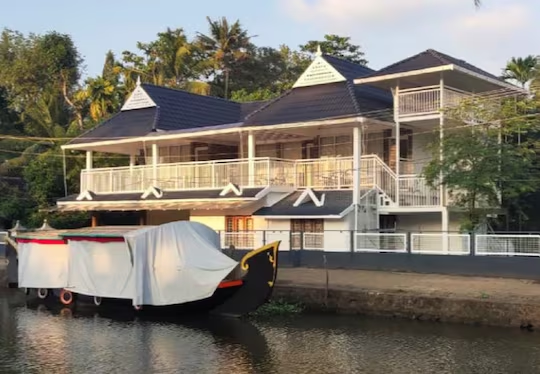
- Why Evaan’s Casa fits this search intent: We’re a dot on that map you can’t reach by road, a six-minute boat ride from the jetty. Staying here means your personal map of Alleppey starts with the quiet rhythm of island life.
I was up before the sun this morning, sitting on the steps that go right into the water. The only sound was the soft *plink* of a fish breaking the surface and the distant, rhythmic putter of an early fishing boat’s engine. The mist was still clinging to the tops of the coconut palms. In that quiet, I thought about how many people look at an Alleppey map online, trying to plot their journey here. They see the blue veins of the backwaters, the outline of the town. But the map doesn’t show this silence. It doesn’t show the way the light hits the water at 5:30 AM, turning it the colour of old silver. That’s the thing about maps. They give you coordinates, not context.
What Is an Alleppey Map?
An Alleppey map is a starting point. It’s a two-dimensional sketch of a three-dimensional, living world. Most maps you’ll find will highlight the main town, Alappuzha, the broad Vembanad Lake, and maybe the major ferry routes. They’re useful for getting your bearings, for understanding that this is a place defined by water, not roads.
But honestly, I’d say the most important parts of a true Alleppey map are the parts that are missing. The thin, pencil-line canals that wind behind villages. The small islands, like ours, that don’t even have names on most tourist brochures. The location of the best *karimeen* (pearl spot fish) catch of the day, or where you can find a particular type of water lily. A real map of this place is drawn in memories and sensations, not just ink. When you look at an Alleppey map, look for the empty spaces between the labelled attractions. That’s where you’ll find us.
I’m probably biased, but I think the best use of an Alleppey map is to find a point of departure from the expected routes. Locate the main boat jetty. Then, look away from it. Your adventure starts when you decide to travel the channels that aren’t bolded in guidebooks.
Why Does the Island Location Matter?
It changes everything. When you arrive at the mainland jetty, our boatman, Rajan, will be waiting. The ride to Evaan’s Casa takes six minutes. That’s the official measurement. But in those six minutes, the noise of scooters and autorickshaw horns fades completely. It’s replaced by the diesel thrum of our boat and the splash of water against the hull.
There is no road here. No cars. The only way to our door is by water. That isolation isn’t about being cut off. It’s about being connected to a different pace. You wake up to the sound of water, not traffic. Your afternoon might be interrupted by a neighbour paddling by in a canoe, not a delivery van. The island location forces a gentle slowness. You can’t rush. You have to wait for the boat. You have to plan around the light and the tide, not a taxi app.
This matters because it reshapes your experience of the Alleppey map. You’re no longer a dot moving between pinned locations on a digital screen. You become part of the landscape the map tries to represent. The water isn’t just something you look at from a houseboat deck; it’s your front yard, your pathway, your morning view with a cup of chai. Most people skip this, but staying on an island lets you see the backwaters when the day boats have gone home. That’s when the herons come out to fish and the water turns still as glass.
What Home-Style Food Can You Expect Here?
The food is the soul of the place. It’s prepared in the kitchen at our homestay, following the rhythms of traditional home cooking. The aromas tell the story of the day: the sharp, clean scent of chopped ginger in the morning, the deep, earthy smell of turmeric and roasted coconut in the afternoon, the sizzle of mustard seeds crackling in coconut oil at dusk.
Breakfast might be soft, lacy appam with a mild, fragrant vegetable stew, or puttu – steamed cylinders of rice flour and coconut – with kadala curry, a black chickpea dish that is pure comfort. The coconut is from trees on the island, grated fresh. The spices are ground daily. It’s simple, but that’s the point. Lunch and dinner are often served on a banana leaf. You might have karimeen pollichathu, where the pearl spot fish is marinated in a masala, wrapped in a banana leaf, and pan-fried until the leaf blackens and infuses the fish with a smoky sweetness.
On request, we can serve a full Kerala Sadhya, the traditional feast. It’s an array of dishes, from tart mango pickle to creamy avial, from sour pulissery to crisp pappadam, all meant to be eaten in a specific order with your hands. The experience is as important as the taste. Feeling the cool, smooth banana leaf, mixing the rice with different curries, understanding how the flavours play off each other – it’s a meal that engages all your senses. It’s locally prepared, using what’s fresh and good from the nearby markets and our own garden.
Jackson’s Practical Tips for Visitors
Look, here’s the thing. A lot of advice is generic. Here are a few specifics from someone who has lived here all his life.
- **The Boat to the Mainland:** Our last boat back from the main jetty is at 7:30 PM. It’s not a strict deadline, but communicate with us if you’ll be later. After dark, the canals aren’t lit, and navigation is for local experts only. Plan your dinners in town accordingly.
- **Skip the Crowded Main Market:** Instead, ask Rajan to take you to the small, floating vegetable market that happens at the canal junction near Champakulam very early in the morning. It’s all local vendors in canoes. It’s chaotic, beautiful, and real.
- **What to Pack:** Seriously, pack less than you think. Bring quick-dry clothes, a solid hat, and sunscreen. But also, bring a pair of socks you don’t mind getting wet. You’ll take your shoes off constantly before entering homes, boats, and some shops. Dry socks are a small luxury after a day of that.
- **For a Quiet Backwater Cruise:** Don’t just book a big houseboat for the day. Hire a small, non-mechanised canoe (a *vallam*) for two or three hours in the late afternoon. The silence is profound. You’ll glide past water lilies, spot kingfishers, and see daily life along the banks without the engine noise. This is the Alleppey map at its most intimate scale.
- **A Specific Snack:** On the mainland, near the boat jetty, there’s a tiny stall that sells *ada* (a steamed rice cake with a sweet coconut-jaggery filling) wrapped in banana leaf. It’s the perfect thing to eat, still warm, while you wait for your ride. Costs about ten rupees.
What Is the Best Time to Visit Alappuzha for an Alleppey Map?
It completely depends on what you want your map to contain. Each season redraws the landscape.
**Monsoon (June to September):** The backwaters are fullest. The rain is heavy, dramatic, and constant. The sound on our tin roof is incredible. Everything is a shocking, luminous green. The downside? Boat trips can be cancelled if the weather is rough. You need to be okay with staying put, reading a book, and watching the rain. Some guests disagree with me on this, and that’s fair – they find the humidity and rain limiting. I find it the most authentic and powerful season.
**Winter (November to February):** This is the classic, postcard season. The weather is mild and sunny, with cool evenings. The light is golden. It’s perfect for all activities – cruising, cycling on the island paths, exploring. It’s also the busiest time. Your Alleppey map will be shared with more other travellers. Book well in advance.
**Summer (March to May):** It gets hot. Really hot in the afternoons. The advantage is that it’s the quietest period. You’ll have canals to yourself. Mornings and late afternoons are still lovely. The key is to adopt the local rhythm: active early, a long rest in the shade during the peak heat, active again as the sun dips. The mangoes are in season, which is a major culinary bonus for the home-style food you’ll eat.
Frequently Asked Questions About the Alleppey Map
How far is Evaan’s Casa from the Alleppey town centre?
By road and boat, it’s about a 20-minute drive from the KSRTC bus stand to our jetty, then the six-minute boat ride. In terms of feeling, it’s a world away. The distance isn’t measured in kilometres, but in the drop in decibel level and the increase in kingfisher sightings.
Is it safe to travel on the backwaters?
Yes, absolutely. The boatmen have generations of knowledge. Life jackets are provided. The main safety tip is to listen to your guide about where to swim – some areas have strong currents. The water in the smaller canals near our island is generally calm and safe.
What should I definitely bring?
Beyond the basics, bring a good mosquito repellent (we have nets, but it’s wise), a reusable water bottle, and a power bank. While we have electricity, experiencing the island might mean being away from plugs. Also, bring an open mind about schedules. Things here often operate on “island time.”
Is WiFi available?
We have a WiFi connection at the homestay. It’s reliable for messaging and emails. It’s not always strong enough for high-definition streaming or large video calls. Honestly, that’s often a good thing. Part of the point of consulting an Alleppey map and coming to a place like this is to disconnect a little. The connection to the water and the sky is more reliable here anyway.
So that’s my take on the Alleppey map. It’s a tool, but it’s not the territory. The territory is the cool mud under your feet as you get into the boat. It’s the taste of sweet black tea as you watch the evening settle over the water hyacinths. It’s the specific, quiet magic of returning to an island as the stars come out, guided by the single light on our porch. Your map will fill with these personal landmarks, places no printed guide could ever mark. If you’re looking to start your own map from a place of stillness and home-style warmth, we’d be happy to be your first point of reference. You can learn more about Evaan’s Casa and what a stay here feels like. However you choose to explore, I hope your map leads you to moments of quiet wonder. Just like that silver water this morning.