- By :
- Comments: 0
homestay for 2 nights Alappuzha
homestay for 2 nights Alappuzha
Last Updated: September 07, 2026
Quick Answer: homestay for 2 nights Alappuzha
- Choose a homestay for 2 nights Alappuzha if you want the backwaters without the tourist rush — stay on an island reached only by boat.
- Insider tip: arrive before 5 PM so you catch the ferry from Punamada Jetty and see the paddy fields turn gold in the evening light.
- Evaan’s Casa fits because it’s a working island, not a resort — 6 minutes from the road, surrounded by water and fields.
A guest from Germany stood on our veranda last month, holding her coffee, and said nothing for a full minute. I thought something was wrong. She turned and asked, “Is the water always this quiet?” I laughed. She meant the absence of engines, of traffic, of everything that hums at home. On our island, the loudest thing at 7 AM is the coppersmith bird hammering in the palm behind the kitchen. That moment stuck with me because she’d booked a homestay for 2 nights in Alappuzha expecting scenery. What she got was silence she didn’t know she needed.
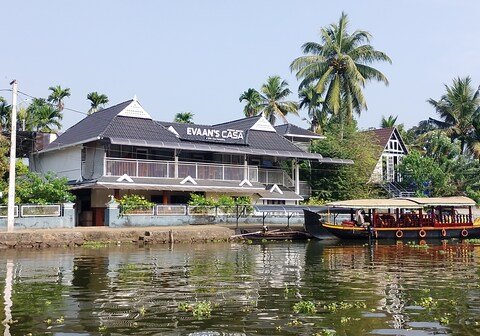
I’m Jackson. I grew up on these backwaters, not on a houseboat but on solid ground, mud under my feet and water at the edge of every memory. Our place, Evaan’s Casa, sits on a small island in Vembanad Lake, off the main channel near Alappuzha town. No road reaches us. You park at Punamada, and I come with the boat. Six minutes across. That’s it. That short crossing is the line between your normal life and what happens here.
What can you see from homestay for 2 nights Alappuzha?
From the veranda, the first thing you notice is the paddy. Not a manicured lawn, but actual fields that flood and drain with the seasons. In December and January, the water recedes and the green shoots come up, so close you could toss a coconut into them. By mid-year, the rain swells the lake, and the same fields turn into shallow sheets of silver, reflecting the sky like broken mirrors. You’ll watch this change happen over your morning coffee. Most guests sit longer than they planned. I don’t rush them.
Then there’s the water itself. It’s not sea water and it’s not river water — it’s the brackish mix of Vembanad, brownish green, lively with fish. At dawn, you’ll see the local fishermen in their vallams, long wooden canoes with a distinctive diesel hum that carries across the surface. They cast nets that catch the light. I’ve seen kingfishers dive so close to the veranda that guests flinch. The birds here don’t know they’re supposed to be shy.
Look past the channel, and you’ll see coconut palms crowding every bank. Each one stands at its own angle, some leaning hard over the water like they’re tired. Between them, you catch glimpses of village houses with tin roofs that flash when the sun hits them right. On a clear evening, the whole scene turns ochre and orange. Honestly, I’ve lived here forty years and I still stop when the light does that thing.
What’s around the island once you’re there?
Our island isn’t a resort compound. It’s a real village with maybe two hundred families. Walk ten minutes from the homestay, and you’ll pass a small temple with an oil lamp that’s been burning for generations. You’ll hear the priest’s bell in the morning. You’ll see a woman sweeping her front yard with a coconut broom, raising soft dust that hangs in the humid air. Nobody will bother you. A few might nod. That’s the extent of the interaction, and it’s perfect.
The paddy fields surround us on three sides. They’re not empty land — they’re worked by farmers who still use methods from decades ago. During the harvest, you’ll see them cutting the stalks by hand, the rhythmic swing of sickles, the bundles stacked in golden piles. The smell of fresh cut paddy mixes with the coconut oil from the nearby press. I’m probably biased, but there’s no better smell in Kerala than that combination in February.
Across the narrow channel from us sits a small hamlet called Mararikulam North. Most people skip this, but the village has a fish market that operates at dawn, and if you’re up early, I can arrange a short boat ride over. The women sit on their haunches with baskets of pearl spot and prawns, haggling in rapid Malayalam. You won’t understand a word. You’ll still feel the rhythm of it. That market, that bustle, that’s the real backwater life that houseboats just glide past.
Can you walk or explore the area nearby?
Yes, but you need to adjust your expectations. There are no paved roads on our island. There are mud paths, raised bunds between the paddy fields, and narrow walkways that follow the water’s edge. You can walk for an hour and cover maybe three kilometres, but you’ll see more than you would in ten kilometres of city street. The paths are safe, dry in the dry season, and a bit slippery after rain. I always tell guests to bring shoes that can handle mud.
One of my favourite walks takes you to the island’s northern tip, about twenty minutes from the house. There’s a small stand of old banyan trees there where the village kids gather after school. They play cricket with a tennis ball and a plank for a bat. If you stand long enough, one of them might offer you a go. It happens more often than you’d think. The path goes past a toddy shop — the local palm wine tavern — where men sit on wooden benches and argue about politics in voices that carry across the water.
If you want more structured exploring, the boat is your answer. I can take you through the narrow canals that connect the island to the mainland, where the water hyacinths cluster and the dragonflies hover in pairs. We’ll pass under low bridges where you have to duck, past washermen beating clothes on flat stones, past a small Catholic church with a red-tiled roof that’s been there since the Portuguese era. The round trip takes an hour and costs nothing extra. I do it because I love showing people what’s actually here.
For a longer excursion, the town of Alappuzha is a short boat ride plus an auto-rickshaw away. The beach is crowded and fun, but I’ll be honest — most guests who book a homestay for 2 nights in Alappuzha want the water and the quiet. The town can wait. The island won’t.
Most people skip this, but I’ll tell you: the best time to be on the water is just before the monsoon breaks in June. The air gets heavy, the clouds pile up like grey cotton, and the lake turns a strange, steely colour. Then the first drops hit the tin roof, and the sound is like applause. Guests who experience that never forget it. They also never forget the smell of rain on dry earth — the locals call it manninte manam, the scent of the soil. You can’t bottle that. You can only be here for it.
Meals at the homestay are simple and honest. Home-style Kerala food, prepared fresh by our small team. Fish curry with pearl spot if the catch was good, thoran with grated coconut, fluffy red rice that steams in the humid air. The kitchen uses coconut oil and mustard seeds that splutter in the pan — you’ll smell lunch cooking before you see it. We serve on the veranda when the weather allows. You eat with the water right there, reflecting the sky, and the food tastes better for it.
Some guests ask me if two nights is enough. I usually say it’s the right amount for a first visit. One night is a taste, a tease. Two nights let you settle into the rhythm — you stop checking your phone, you start noticing the way the light moves across the paddy, you sleep through the night without waking. Three nights is for people who want to truly disconnect. But for most travellers, a homestay for 2 nights in Alappuzha gives them the full arc of island life: one full day to explore, one full evening to just sit and breathe. It works.
The rooms themselves are clean and uncomplicated. Lake views from the windows, fans that stir the warm air, mosquito nets over the beds that you’ll actually appreciate at dusk. Hot water is available in the attached bathrooms, though most guests end up showering cool anyway — the heat makes it welcome. The veranda is the real luxury, though. It opens straight onto the water, with steps going down to the lake edge. You can sit there with a book and not turn a page for an hour. Nobody will judge you.
We do have WiFi, but it’s honest WiFi — good enough for checking messages, not for streaming movies. Some guests disagree with that, and it’s fair. But I’ve noticed the ones who complain about the connection are often the same ones who, by the second morning, have stopped asking about it. They’re too busy watching the cormorants dry their wings on the bamboo poles. Look, here’s the thing: you can get full signal anywhere in the world. You can’t get this.
If you’re considering a homestay for 2 nights in Alappuzha, I’ll be straight with you. There are fancier places. There are places with air conditioning and swimming pools and buffet breakfasts. But those places are not islands. They don’t have paddy fields changing colour at their doorstep. They don’t have the diesel hum of a vallam at dawn or the woodsmoke from a neighbour’s kitchen curling over the water. They don’t have the feeling of being genuinely, completely surrounded by the backwaters, not just looking at them from a deck.
Come stay with us at Evaan’s Casa. I’ll meet you at the jetty. The boat ride is six minutes. After that, time moves differently.
Frequently Asked Questions About homestay for 2 nights Alappuzha
How far is Evaan’s Casa from Alappuzha town?
The town centre is about 4 kilometres by road, but you’ll need the boat first. It’s a 6-minute crossing from Punamada Jetty, then a short auto-rickshaw ride to town. The whole journey takes about 25 minutes door to door. Most guests go into town once during their stay and are happy to return to the quiet.
Is the island safe for solo travellers or families with kids?
Yes, very much so. The island community is close-knit, and everyone knows everyone. Kids love the boat ride and the freedom to walk the paths, though younger children should be watched near the water — there’s no railing along the edge. Solo travellers, especially women, have told me they felt completely at ease here. The only danger is falling asleep on the veranda and waking up an hour later, sunburned and relaxed.
What should I bring for a 2-night stay?
Light cotton clothes, insect repellent for the evenings, and shoes you don’t mind getting a bit muddy. A flashlight is useful if you plan to walk after dark, though the paths are lit by moonlight on clear nights. Bring a book you’ve been meaning to read — you’ll actually finish it here. And leave your formal shoes at home; you won’t need them.
Is WiFi available at the homestay?
We have a connection, and it works for emails and messaging. Video calls can be patchy. If you’re on a digital detox, this is a blessing in disguise. If you absolutely must stream or attend online meetings, I’d recommend checking the signal during your first evening and planning around it. Most guests find they need the internet far less than they thought.
I’ll end with this. The other day, a couple from Mumbai checked out after their two nights. They’d barely spoken to each other at breakfast on the first morning — phones out, scrolling. By the second evening, I saw them sitting on the veranda steps, shoulder to shoulder, just watching the water. No phones. No words. Just the light fading and the birds settling in for the night. The husband shook my hand before they left and said, “We forgot what silence sounded like together.” That’s what a homestay for 2 nights in Alappuzha can give you. Not a holiday — a return. The boat’s waiting. So am I.
Plan your stay at Evaan’s Casa
- Lake view homestay in Alleppey (Alappuzha)
- Where to stay in Alleppey: the complete guide
- Alleppey room booking: rooms and prices from ₹1,900
- Budget homestay in Alleppey under ₹2,000
- Backwater homestay on Vembanad Lake
- Punnamada homestay, Alappuzha
- Family homestay in Alleppey
- Honeymoon package and couple stay
Book direct on WhatsApp +91 88484 96667