- By :
- Comments: 0
homestay near beach Alappuzha
homestay near beach Alappuzha
Last Updated: September 04, 2026
Quick Answer: homestay near beach Alappuzha
- Evaan’s Casa is an island homestay near Alappuzha beach, reached by a six-minute boat ride across Vembanad Lake.
- Most people skip the early 6:15 AM country boat from the Punnamada jetty — take it, and you’ll see the water before the sun burns off the mist.
- If you want the beach and the backwaters without the noise of town, this is the closest you’ll get to both from one quiet patch of land.
The first thing guests say when they step off the boat is never about the view. It’s about the silence. Not the kind of silence that feels empty — the kind that feels full. Full of coppersmith barbets calling from the coconut crowns, water lapping at the wooden jetty, and the faint rustle of paddy leaves when the breeze moves through. No engines. No horns. No distant radio from a tea shop. Just the island breathing.
Honestly, I’ve watched it happen a hundred times. A guest stands there, bag in hand, and just stops. They close their eyes for a second. Some of them laugh, a little nervous, like they’ve walked into a dream by accident. Others just stand very still, letting the quiet wash over them. That moment — that first exhale — is why I keep doing this.
How do you actually reach homestay near beach Alappuzha?
There’s no road to our island. No bridge, no auto-rickshaw, no winding concrete path. That’s the whole point. You reach Evaan’s Casa the same way the rice and coconuts and people of this village have always moved — by water.
You start from the Punnamada side of Alappuzha town. If you’re coming from the beach, which is about four kilometres away, you can grab an auto or a cycle-rickshaw to the jetty. The ride takes maybe fifteen minutes through the market streets, past the fish stalls and the spice shops, where the air gets thick with dried chilli and cardamom. Then you turn down a narrow lane lined with old wooden houses, and suddenly the road ends at the water.
The jetty is unassuming. A few concrete steps going down, some fibre boats tied up, and a man selling tender coconuts from a small shack. You’ll see our boatman, Raju, waiting there with a wide smile and a blue plastic stool for you to sit on. He’s been ferrying guests for over a decade now. He knows the water the way I know my own veranda.
The boat ride itself is six minutes. That’s it. Six minutes between the chaos of town and the quiet of the island. Some guests are surprised it’s so short. Others ask if we can go slower. We can, if you ask nicely. Raju doesn’t mind.
What is the boat ride across the backwaters like?
The engine starts with a low cough, then settles into a steady putter that vibrates through the wooden seat. The water here is dark and glassy near the jetty, reflecting the sky in patches. As you pull away from the shore, the town noise fades fast — first the honks, then the shouts, then the general hum of human hurry.
Within a minute, you’re in the middle of the channel. On your left, a row of coconut palms leans over the water like they’re trying to see their own reflections. On your right, paddy fields stretch out in flooded green squares, divided by narrow bunds where egrets stand motionless, waiting for fish. The water turns a lighter shade of green here, stained by the lake’s edge and the slow movement of currents.
If you’re lucky, you’ll pass a vallam — a traditional wooden canoe — carrying a farmer and his harvest. He’ll wave. You’ll wave back. That’s the custom. Nobody on these waters passes without acknowledging each other. It would be bad manners, and the water remembers.
The boat turns left at the second channel marker, a weathered post with faded paint. This is the part where most guests gasp a little. The channel narrows, the palms close in overhead, and for a moment you’re gliding through a green tunnel. The engine echoes off the water in a way that feels intimate, like the lake is listening too. Then the channel opens up again, and there we are — our little island, with its tiled roof and the veranda that hangs right over the water.
What do you notice first when you step onto the island?
The jetty boards creak under your feet. That’s the first sound. A warm, wooden creak that says this place has been here a while, and it’s not pretending to be anything else. Then you smell it — the faint woodsmoke from the kitchen chimney, mixed with the green smell of freshly cut banana leaves. Someone’s been preparing the afternoon meal.
Look down for a second. The water is so clear near the jetty that you can see tiny fish darting between the wooden posts. They scatter when your shadow falls on them, then regroup almost instantly. On the other side of the island, the lake stretches wide and open, all the way to the distant shore where you can just make out the white spire of a church and the darker green of the mainland’s coconut groves.
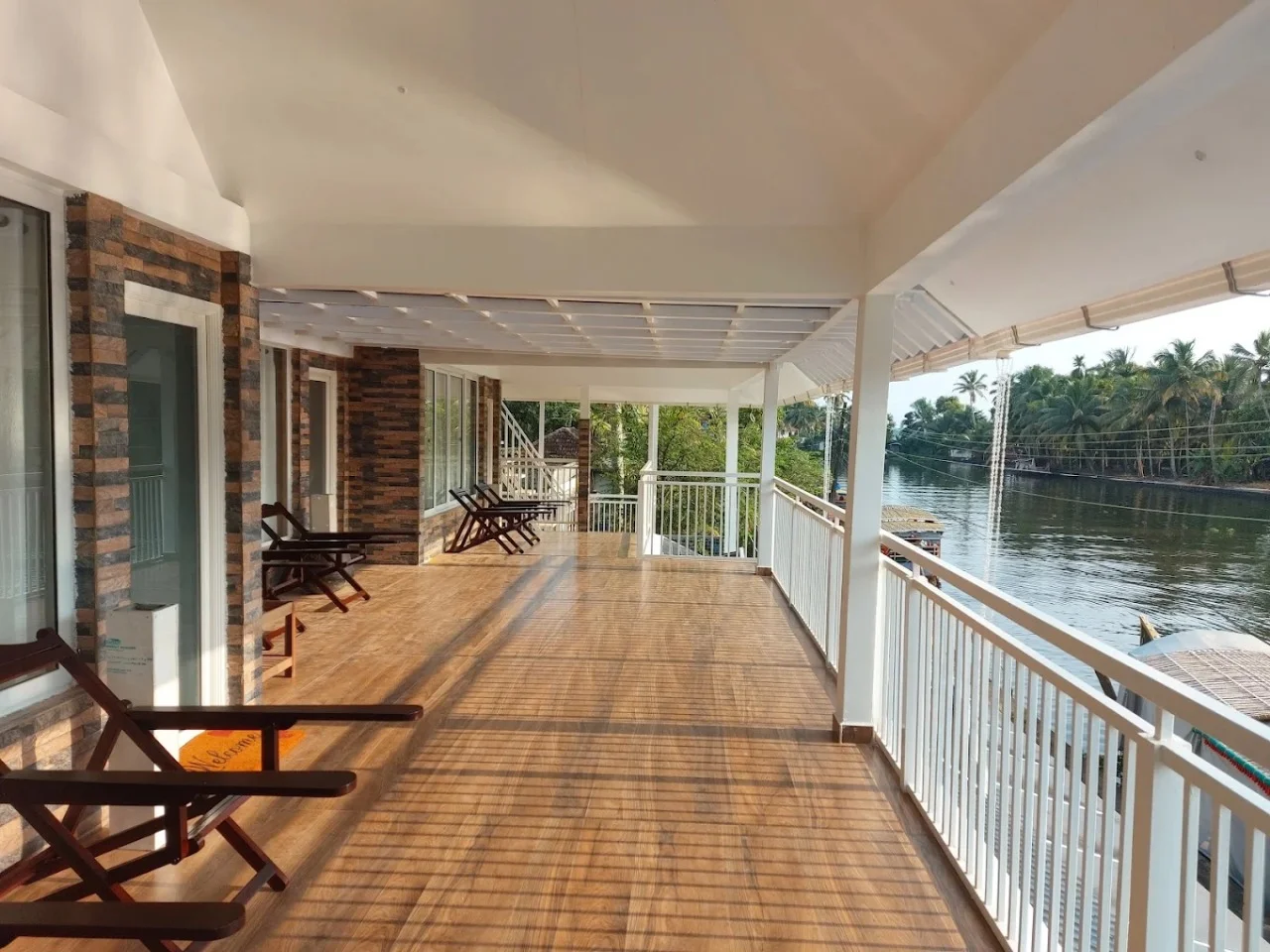
The veranda is where everyone ends up. It wraps around the front of the house, shaded by a sloping roof and open to the water on three sides. There are hammocks strung between the pillars, and low wooden chairs that have been sanded smooth by years of use. A gecko calls from somewhere in the rafters — a sharp, two-note chirp that sounds like it’s asking a question. Most guests sit here for a long time before they even think about unpacking.
Our rooms are simple. That’s deliberate. Clean white walls, a bed with white cotton sheets, a mosquito net that hangs from the ceiling like a soft cloud, and a window that opens directly onto the lake view. There’s a ceiling fan that makes a gentle clicking sound on its lowest setting, and a private bathroom with hot water for the evenings. No television. No air conditioning. The lake breeze does that job better than any machine.
The food here is home-style Kerala food, prepared in the homestay kitchen with ingredients from the island and the nearby villages. Meals are served on the veranda when the weather is fine, which is most of the time. You’ll eat karimeen pollichathu — pearl spot fish wrapped in banana leaf — with steamed rice and a thoran made from local greens. The mustard seeds crackle in coconut oil as they hit the hot pan. You can hear it from the veranda. That sound means lunch is close.
Most people skip the early morning, and that’s their loss. The 6:15 AM country boat that runs between the island and the mainland is not for tourists — it’s for the schoolchildren and the market-goers and the women heading to town with baskets of fresh catch. But if you ask nicely, you can ride along. The water is glassy flat at that hour, and the mist hangs low over the paddy fields like a secret being kept. The kingfishers are out. The air smells of wet earth and diesel smoke from the boat’s old engine. It’s the real Kerala, the one that doesn’t perform for anyone.
I’m probably biased, but I think the best hour here is the one just before sunset. The light turns golden and soft, and the water becomes a mirror for the sky. If you’re sitting on the veranda with a cup of chai, you’ll see the fishing boats heading home, their lamps just beginning to flicker on. The coots paddle in lazy circles. A heron stands motionless at the water’s edge, patient as stone. Nobody speaks. Nobody needs to.
If you’re looking for a homestay near beach Alappuzha but you want more than just a room with a sea view, this is where the difference lies. The beach is close enough for a day trip — you can be there in twenty minutes by boat and auto — but you come back here, to the quiet, to the water, to the sound of wind moving through palm fronds. Some guests disagree with that balance, and that’s fair. They want the sand and the surf all day, every day. But for those who want both, who want the lively beach and then a retreat from it, this island holds a particular kind of magic.
There’s a small island market that happens every Friday on the neighbouring shore. It’s not on any tourist map. You’ll find fresh vegetables, dried fish, and a woman who makes the most incredible banana fritters you’ve ever tasted. I can arrange a trip there if you’re interested. It’s a slice of village life that most visitors never see.
The rooms here are simple, but they’re clean, and the lake views are unobstructed from every window. Fans and mosquito nets are standard. Hot water is available in the evenings. And the veranda — that long, open space that hangs over the water — will become your favourite spot. I guarantee it. Guests who come for two nights often extend to five, just because they can’t bear to leave that veranda.
If you’re planning a trip to this part of Kerala, consider what you actually want from your stay. The beach at Alappuzha is beautiful, yes. The backwaters are iconic. But a homestay near beach Alappuzha doesn’t have to mean you’re stuck in the middle of town. You can have both — the vibrant beach life and the deep, restorative quiet of an island. You can have Evaan’s Casa.
Frequently Asked Questions About homestay near beach Alappuzha
How far is Evaan’s Casa from Alappuzha beach?
The beach is about four kilometres away by road, plus the six-minute boat ride. In total, you’re looking at around twenty to twenty-five minutes from our veranda to the sand. Most guests go in the morning, spend a few hours there, and come back for lunch on the veranda.
Is the boat ride safe, especially at night?
Yes. Raju has been navigating these waters for over twenty years. He knows every sandbar, every current, every patch of submerged vegetation. The boat is well-maintained, and life jackets are available for every guest. Night rides are actually beautiful — the water reflects the stars, and the sounds of the island carry across the lake in a way that feels almost magical.
What should I bring for a stay on the island?
Light cotton clothes, sandals that can get wet, and mosquito repellent if you’re sensitive to bites. We provide the nets and the fans, so you don’t need to worry about that. A good book is recommended, and a camera if you want to capture the sunrises. Everything else, we have covered.
Is WiFi available at the homestay?
We have WiFi, but honestly, it’s not the fastest. The signal comes from the mainland, and it can be temperamental on cloudy days. Some guests love this — it forces them to disconnect. Others need to check in with work, and for that, the connection is usually sufficient. Most people find they use it less than they expected. The view is more interesting than a screen.
Can I bring my children to the island?
Absolutely. Kids love the boat ride, the water, and the freedom of an island with no traffic. We have life jackets in small sizes, and the veranda is safe with a sturdy railing. There’s plenty of open space for running around, and the island itself is quiet enough that you won’t have to worry about them wandering off.
How much does a stay cost?
It depends on the season and the length of your stay. Prices are reasonable — much lower than the big resorts on the mainland — and include breakfast and dinner. For the experience of an entire island to yourself, with the lake on three sides and the paddy fields on the fourth, I think it’s a fair trade. If you visit during the monsoon, from June to September, there are often better rates. The rain on the tin roof is an experience in itself.
The monsoon here is something else entirely. The rain comes down in sheets, hammering the roof with a sound like a thousand drummers. The lake rises, and the water turns a deep, churning brown. The frogs sing louder than the rain. Some guests are afraid of the weather during those months, but I tell them to wait. Just sit on the veranda, wrapped in a blanket with a cup of hot chai, and watch the storm roll across the water. It’s terrifying and beautiful and absolutely safe. The island has weathered these monsoons for centuries.
When the rain stops, the air is cleaner than anywhere you’ve ever been. The coconut palms drip, and the water is still and silent again. That’s the rhythm of this place. Storm and calm, noise and silence, movement and stillness. It all happens in equal measure, and the island absorbs it all.
Whenever you decide to come, and whenever you find your way to our jetty, Raju will be there with his blue stool and his wide smile. The boat engine will cough to life. The six-minute ride will pass too quickly, or just right, depending on how much you need the quiet. And when you step onto our island, you’ll understand why I’ve never wanted to live anywhere else.
The water — it gets into you. I’ve seen guests leave with wet eyes, promising to come back. Some of them do. Some of them send postcards. Some of them just stay in touch through the years, telling me about their lives, their families, their own patches of quiet they’ve found. That’s the thing about a place like this. It doesn’t just hold you for a few days. It stays with you, like the memory of a good dream, like the sound of water against wood, like the feeling of silence that isn’t empty at all.
If you’re searching for a homestay near beach Alappuzha, I hope you’ll consider our island. Not because it’s the easiest option, or the most convenient, or the most luxurious. But because it’s real. The wood creaks, the water laps, the birds call at dawn, and the rain sounds like music on the roof. That’s what we offer. That’s all we offer. And for the right traveller, that’s everything.
Come see us sometime. The boat leaves every day, and the kettle is always on. Evaan’s Casa is waiting, and so am I.