- By :
- Comments: 0
5 star homestay Alappuzha
5 star homestay Alappuzha
Last Updated: August 23, 2026
Quick Answer: 5 star homestay Alappuzha
- A true 5 star homestay Alappuzha isn’t about marble floors — it’s about waking up to silence and water, and we have that in spades.
- Insider tip: take the 7:15 AM country boat from the Alappuzha jetty to see the paddy fields before the sun gets loud.
- Evaan’s Casa fits because we give you the calm of an island with the comfort of clean rooms and honest Kerala food.
The first thing guests notice isn’t the view. It’s the quiet. There’s no road hum, no honking, no distant siren. Just the slap of water against the wooden jetty and the call of a kingfisher that thinks it owns this stretch of Vembanad Lake.
I’ve watched people stand on the veranda and just breathe. They don’t say anything for a full minute. Then they laugh, a little embarrassed, and ask if it’s always this still. Most days, yes. The mornings get a chorus of birds and the evenings bring a low frog orchestra, but the traffic noise? That’s a memory from the mainland.
Honestly, I think that’s what people mean when they search for a 5 star homestay Alappuzha. They don’t want a chandelier. They want this.
What can you see from 5 star homestay Alappuzha?
From our veranda, you’re looking at a living postcard. The paddy fields stretch out in patchwork greens, some bright like new grass, others deep and muddy where the workers have just harvested. Between the fields, narrow canals cut through like silver threads, and every few minutes a small canoe drifts by carrying coconuts or someone’s groceries.
The water around us changes mood constantly. At dawn it’s glassy and pink. By noon it’s a sheet of white light that makes you squint. In the late afternoon, clouds pile up over the lake and the water turns gunmetal grey. I never tire of it, and I’ve been watching this same view for forty years.
Our rooms face the water directly. You don’t have to walk anywhere to see it — you just open your eyes. The windows are screened, not sealed, so you get the breeze and the sound of the lake. The fans do the rest when the air is still.
Across the lake, you can spot the village of Kainakary. That’s where the old church tower pokes above the palm line. Some guests bring binoculars and try to count the fishing boats. I always lose count around nineteen.
What’s around the island once you’re there?
We’re on a small island that most maps don’t bother naming. It’s about a six-minute boat ride from the Alappuzha jetty, and there’s no road access. That’s the point. You leave your car behind and become a boat person for a few days.
The island itself has maybe forty families. They grow rice, fish, and tend coconut trees. When the monsoon hits, the water level rises and the entire island feels like it’s floating — because it sort of is. The locals just shrug. They’ve been living this way for generations.
You can walk the island’s one narrow path that loops around the paddy fields. It takes about twenty minutes at a slow pace. You’ll pass a small temple with a red flag, a tea shop that opens at 6 AM and closes when the kettle runs out, and a few houses with goats tied to the porch.
The nearest village with shops is Kainakary, a short boat hop away. There you’ll find a pharmacy, a couple of general stores, and a fish market that’s best visited before 9 AM. The women there sell karimeen, pearl spot, and prawns that were swimming an hour earlier.
Most people skip this, but I always suggest a sunset boat ride through the narrow canals near the paddy fields. The light filters through the palms and the water turns the colour of tea with milk. It’s not on any tour list. It’s just what we do.
Can you walk or explore the area nearby?
Yes, but with a caveat. You can walk on our island, and you can walk in Kainakary village, but you can’t walk to the mainland. The lake is the road here. That’s part of the charm, but it also means you plan your movements around boat timings.
The public ferry from Kainakary to Alappuzha runs every hour from 6 AM to 7 PM. The fare is eight rupees, and it’s not a tourist boat — it’s how people get to work, school, and the hospital. I recommend taking it at least once. The school kids will grin at you, and the boatman will ask where you’re from and whether you’ve tried the morning dosa at the jetty canteen.
If you want a longer walk, take the ferry to Kainakary and follow the bund path south. It’s a raised mud track between the paddy fields, and it goes on for about three kilometres. You’ll pass duck farms, a toddy shop that looks closed but isn’t, and at least one old man who will wave and ask for news from the city.
On the island, the walking is gentler. The path is packed earth, and after rain it gets slippery, so we keep old rubber slippers near the door for guests. There’s no street lighting, so bring a torch or a phone with charge if you’re out after dark. The frogs get loud, but nothing here bites that you need to worry about.
Some guests disagree, and that’s fair — but I think the best exploration is the kind you don’t plan. Sit on the veranda and watch. A boat will pass with a family heading to the mainland. A heron will stand motionless in the shallows for twenty minutes. The afternoon rain will drum on the tin roof and you’ll realise you haven’t checked your phone in hours. That’s the real activity here.
If you want a structured experience, we can arrange a guided canoe ride through the backwater villages. It’s a two-hour loop that takes you past old Catholic churches, toddy shops, and women washing clothes on stone steps. The guide is my neighbour, Raju, and he knows every bird and every shortcut on this lake.
We’re not a conventional luxury place. We don’t have a pool, a spa, or a restaurant with a wine list. What we offer is something scarcer: a room where the only sound is birdsong, meals that taste like Kerala, and water on every side of you. I’m probably biased, but I think that’s the truest version of a 5 star homestay Alappuzha can offer. You can see more about our rooms and the island at Evaan’s Casa.
The meals here are prepared at the homestay, and they’re simple Kerala food. Fish curry with red rice, thoran with grated coconut, sambar that’s been simmering since morning. We serve everything on banana leaves when we can, and the kitchen uses mustard seeds in coconut oil the way my whole life has tasted. If you’re vegetarian, that’s no problem — the vegetable stew and appam will make you forget about meat.
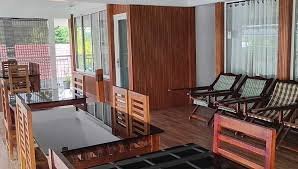
The rooms have thick cotton curtains and mosquito nets that hang from the ceiling like a canopy. The hot water is solar-heated, so sunny days mean strong showers and cloudy days mean a warm trickle. The fans are ceiling-mounted and old, but they move a good amount of air. The veranda is the real living space — cane chairs, a low table, and a view you won’t tire of.
Frequently Asked Questions About 5 star homestay Alappuzha
How far is the homestay from Alappuzha town?
It’s a six-minute boat ride from the Alappuzha jetty. Add another ten minutes if you’re coming from the bus stand or railway station. No roads connect to our island, so the boat is the only way — and that’s exactly how we like it.
Is it safe for solo travellers or families?
Yes, completely. The island is tiny and everyone knows everyone. Children can run around the path safely, and the water edge is shallow near the jetty. Solo travellers often say they felt more at peace here than anywhere else in their trip. The ferry runs till 7 PM, so you’re never stranded.
What should I bring to the homestay?
Light cotton clothes, mosquito repellent for the evenings, and a torch if you plan to walk after dark. Flip-flops for the muddy paths are useful, and a hat for the boat ride. We provide towels, soap, and mosquito nets, so you don’t need to pack heavy. Also, bring cash — the island has no ATM, and the tea shop doesn’t take cards.
Is WiFi available at the property?
We have a basic WiFi connection that works for messaging and email, but it’s not fast enough for video streaming. Honestly, most guests are happy about that. The signal drops during heavy rain, which is when you’ll be reading a book or napping anyway. If you need constant connectivity, this might not be the place for you — but that’s also the point.
I’ve had guests arrive with plans to “do” Alappuzha — the backwater tour, the lighthouse, the market. By day two, most of them cancel the tours. They stay on the veranda with a book, or take the ferry to Kainakary for no reason other than the ride. The houseboat crowds drift past in the distance, and I see guests watching them with a smug little smile. They know something those tourists don’t.
The best time to visit is between October and February, when the weather is dry and the paddy fields are at their greenest. Monsoon months (June to September) have a raw beauty — the rain is loud, the lake swells, and the whole island smells of wet earth — but some travellers find it too intense. Come in the dry season if you want easy walks. Come in the monsoon if you want to feel alive.
There’s a small moment I look for in every guest. It happens on the second or third morning, when they stop reaching for their phone first thing. They just lie in bed and listen to the birds and the water. That’s when I know they’ve got it. They’ve understood what this place is for.
If you’re looking for a 5 star homestay Alappuzha that feels like a hotel, we’re probably not it. But if you want a room that opens onto a lake, meals that taste like home, and an island that slows you down to its own pace, then you’ll find what you’re looking for here. Take the boat out, leave the road behind, and give yourself a few days to just breathe. The water will do the rest. You can see more photos and get in touch at Evaan’s Casa.
Plan your stay at Evaan’s Casa
- Lake view homestay in Alleppey (Alappuzha)
- Where to stay in Alleppey: the complete guide
- Alleppey room booking: rooms and prices from ₹1,900
- Budget homestay in Alleppey under ₹2,000
- Backwater homestay on Vembanad Lake
- Punnamada homestay, Alappuzha
- Family homestay in Alleppey
- Honeymoon package and couple stay
Book direct on WhatsApp +91 88484 96667