- By :
- Comments: 0
homestay with countryside view Alleppey
homestay with countryside view Alleppey
Last Updated: August 18, 2026
Quick Answer: homestay with countryside view Alleppey
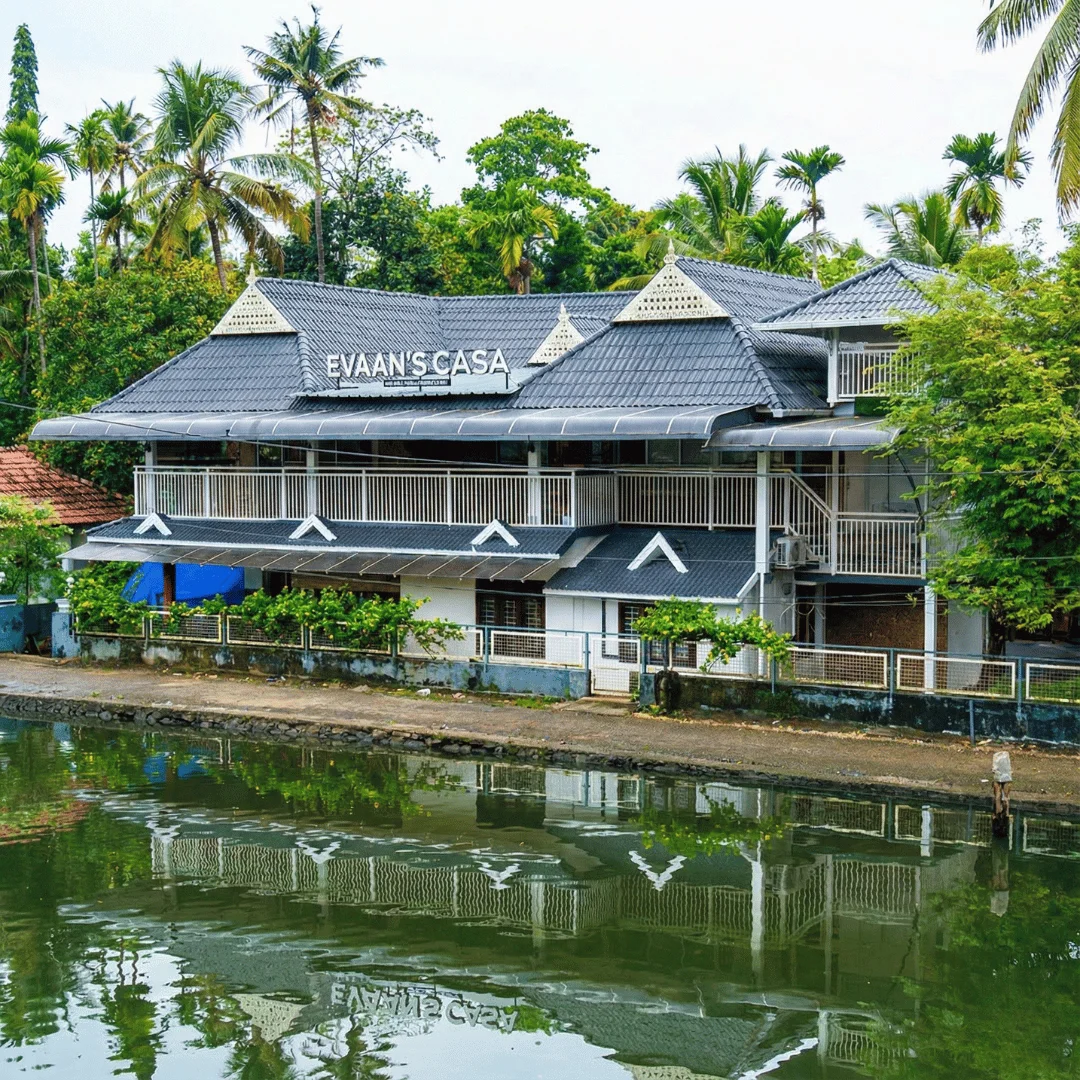
- Evaan’s Casa is a homestay with countryside view Alleppey that sits on its own island, reachable only by a six-minute boat ride across Vembanad Lake.
- Ask for the room facing the western paddy fields — you’ll catch the sunset over the water and the evening heron flights without leaving your bed.
- If you want rice paddies, coconut palms, and a working village around you, with zero road noise, this is the one.
The walk down to the jetty happens every evening, and I still take it slow. The path is packed earth, worn smooth by years of bare feet and bicycle tyres. At dusk, the air smells of woodsmoke from the neighbouring houses and the wet mud left by the last tide. Our boatman, Saji, waits by the water with the engine idling, a low diesel hum that vibrates through your chest. Most guests are already on the veranda by then, watching the light turn to copper.
Honestly, I never planned to host people. I grew up on this island, went to school in Alappuzha town, and came back when my father needed help with the land. The house we live in — the one we opened as Evaan’s Casa — is the same one I was born in. The paddy fields out front were my grandfather’s. The coconut palms were planted before I existed. So when travellers started asking to stay, I said yes, but on my terms. No noise. No parties. Just the island, the water, and the slow rhythm of a place that hasn’t bothered to keep up with the mainland.
Is homestay with countryside view Alleppey really as quiet as people say?
Yes. But quiet in a way you might not expect. It’s not the silence of a closed room or a library. It’s the quiet of a place where sound has room to breathe. You hear the boat engines from the channel, but they fade. You hear birds — cormorants, kingfishers, the occasional white-bellied sea eagle — more than you hear people. And at night, the water laps against the pillars of the veranda with a sound like someone turning pages.
The village itself is a patchwork of small islands connected by narrow canals. There are no cars here. Not one. The only way in or out is by boat, and that changes everything. When you sit on our veranda, you look at rice paddies that stretch flat and green until they hit the lake. You see a farmer wading through the fields, bent over, planting. You see a lone canoe drifting with a fisherman casting a net. There’s no honking, no exhaust, no distant siren. Just the rustle of palm fronds and the occasional call of a boatman.
I’m probably biased, but I think this place teaches you something about listening. Most people arrive with their heads full of itineraries and Instagram captions. By the second day, they’re just sitting. Staring. Breathing. It’s a different kind of quiet — the kind that doesn’t ask anything of you.
What does ‘no road access’ mean for your stay?
It means you plan a little more, and you rush a little less. When you arrive at the Alappuzha jetty, we send a boat for you. The ride takes six minutes, but it feels longer because the world changes around you. You leave the town’s bustle — the auto rickshaws, the fish market, the honking — and then suddenly, you’re on open water. The lake is wide here, almost a mile across. The engine hums. The wind picks up. And then you see the island, low and green, and you realise you’ve already exhaled.
Once you’re here, there’s nowhere to go. That sounds limiting, but it’s actually freeing. The nearest shop is a ten-minute walk and a short boat ride away, in the village of Kainakary. If you need something — toothpaste, a cold drink, a pack of beedis — you can get it, but you’ll have to want it enough to make the trip. Most guests find they don’t want it enough. They’d rather stay put.
The practical side is simple. We serve meals at the homestay — home-style Kerala food, cooked fresh from the market and the garden. Breakfast is usually puttu and kadala, or appam with stew. Lunch and dinner are rice, sambar, thoran, fish fry when the catch is good. You don’t go hungry here. And honestly, you don’t need much else. The rooms are clean and simple — cool tiled floors, a fan, a mosquito net, hot water for showers. The veranda is the real luxury. It opens straight onto the lake, with a couple of cane chairs and a low table. That’s where life happens.
Look, here’s the thing about no road access — it filters people. The ones who come here are the ones who want to be here. They’re not passing through on a tour bus. They’ve chosen this. And that makes for a certain kind of atmosphere. Strangers become conversation partners. Meals are shared. The evening boat ride to watch the sunset becomes a small ritual.
Is this a good place to properly switch off?
Yes, but only if you let it. The internet here is patchy at best — we have a connection, but it’s slow and it drops when the weather turns. Some guests love that; others panic for a day and then relax. There’s no television in the rooms. No pool, no spa, no scheduled activities. What you get instead is time. Time to watch the rain arrive across the lake, a grey curtain sweeping toward you. Time to read the book you’ve been carrying for years. Time to nap in a hammock strung between two coconut palms.
Most people skip this, but I’ll tell you a secret — the monsoon months, June to September, are the most beautiful here. The rain on the tin roof is a sound you’ll remember for the rest of your life. The paddy fields flood, the canals rise, and the whole island turns a green so deep it seems to hum. Yes, it’s wet. But it’s also alive in a way the dry season isn’t. If you come then, bring a good umbrella and a waterproof jacket. The reward is a countryside view Alleppey that almost no one else sees.
There’s a rhythm to the island that you’ll pick up within a day. The morning boat to the mainland leaves at 6:30 AM, carrying schoolkids and vegetable sellers. The evening boat returns around 5:00 PM, bringing back the day’s workers. The lake itself changes moods — glassy in the early morning, choppy by noon, and calm again as the sun dips. The birds follow their own schedule, and after a while, you’ll start to know them by name. The white egrets that stand in the shallows. The kingfisher that perches on the same post every afternoon. The crows that argue over scraps in the yard.
I’ve had guests who came for one night and stayed for a week. I’ve had others who checked out after a day, uncomfortable with the stillness. That’s fair. Some people need movement, noise, stimulation. This place can’t give you that, and it shouldn’t try. But if you’re the kind of person who feels tired by the world — the constant pinging, the traffic, the crowds — then yes, this is the place to switch off. Not because we do anything special, but because we do very little at all.
Most of the time, I just sit on the veranda with a cup of chai and watch the water. I’ve lived here my whole life, and I still haven’t tired of it. The light is never the same. The wind shifts direction. A new boat appears on the horizon, or a heron lands on the railing. There’s always something, even in the stillness. I think that’s the thing people don’t understand about quiet — it’s not empty. It’s full. You just have to be still enough to notice.
If you’re considering a homestay with countryside view Alleppey, I’d say this — come with open time, not a checklist. Leave room for the unexpected. And if you find yourself on our veranda at dusk, watching the sky turn pink over the paddy fields, you’ll understand why I never left. Evaan’s Casa is just a house on an island. But it’s a good house, and it’s in a good place.
Frequently Asked Questions About homestay with countryside view Alleppey
How far is the homestay from Alappuzha town?
The boat ride is about six minutes from the town jetty, plus a short walk to the jetty itself. In total, you’re looking at 20 to 25 minutes from the main town centre. It’s close enough for supplies, but far enough that you won’t hear any of it.
Is it safe for solo travellers, especially women?
Yes. The island is a close community where everyone knows everyone. Our boatman is always available, and we’ll keep an eye on you. I’ve hosted many solo travellers, including women, and none have had any issues. That said, the usual precautions apply — let us know your plans if you’re heading out.
What should I bring with me?
Light cotton clothes, mosquito repellent, sunscreen, a hat, and a good book. If you’re coming in the monsoon, bring a raincoat and flip-flops that can handle mud. Don’t bother with fancy shoes — you won’t need them. And leave the hairdryer at home; the humidity will win anyway.
Is WiFi available at the homestay?
Yes, but it’s slow and unreliable, especially when it rains. I’d suggest treating it as a bonus, not a guarantee. Most guests find that after a day or two, they stop checking their phones altogether. That’s not policy — it’s just the effect of the place.
I’ve probably made this sound like a very quiet place, and it is. But quiet isn’t dull. It’s spacious. It gives you room to think, to talk, to simply be. Some guests leave and say it was the most restful they’ve ever felt. Others say they were bored — and that’s okay too. But if you’re still reading this, you’re probably the kind of person who knows what they’re looking for. Evaan’s Casa will be here. The paddy fields will be green. The lake will be waiting. And I’ll be on the veranda, with a cup of chai, ready to welcome you like I’d welcome a friend.
Plan your stay at Evaan’s Casa
- Lake view homestay in Alleppey (Alappuzha)
- Where to stay in Alleppey: the complete guide
- Alleppey room booking: rooms and prices from ₹1,900
- Budget homestay in Alleppey under ₹2,000
- Backwater homestay on Vembanad Lake
- Punnamada homestay, Alappuzha
- Family homestay in Alleppey
- Honeymoon package and couple stay
Book direct on WhatsApp +91 88484 96667