- By :
- Comments: 0
luxury homestay alleppey backwaters
Last Updated: April 27, 2026
Quick Answer: luxury homestay alleppey backwaters
- A luxury homestay in Alleppey backwaters means staying on a private island with no road access, surrounded by coconut groves and canals, where you eat traditional home-style Kerala food and sleep to the sound of water — not in a crowded houseboat or resort.
- Local insider tip: Most tourists book houseboats for a night, but locals know the real Alleppey experience is on an island homestay like ours, where you can kayak through narrow canals at dawn and see kingfishers dive before the tourist boats start their engines.
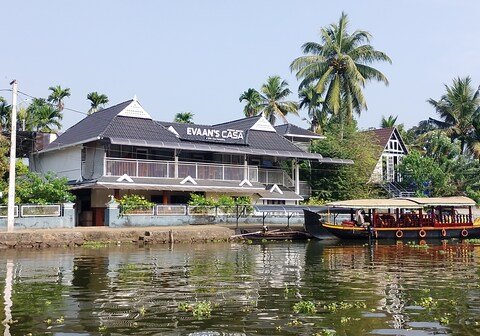
- Evaan’s Casa fits this search intent perfectly — we are a real working island homestay, not a commercial hotel, offering private cottages, all meals prepared locally, and direct access to the backwaters from our property.
I wake up before the sun here. Not because I have to, but because the island pulls me out of bed. The first light hits the coconut palms sideways, long shadows stretching across the water. I walk down to the edge of our property, where the canal meets the main backwater stretch, and I just stand there. The air smells like wet earth and dried palm leaves. A kingfisher sits on the same branch every morning, watching the water like it’s waiting for something important.
That bird has been there longer than I have. Longer than the homestay, probably.
I’m Jackson Louis, and I run Evaan’s Casa — a small island homestay here in Alappuzha, what everyone calls Alleppey. I grew up on these backwaters. Not as a tourist, not as someone who discovered them later in life. I was born here, learned to swim in these canals, rowed a small wooden boat before I could ride a bicycle. So when people search for a luxury homestay alleppey backwaters, I know exactly what they’re actually looking for. They want the real thing, not a polished version of it.
Most tourists arrive in Alleppey with a checklist. Houseboat overnight, spice plantation tour, maybe a snake boat race if the timing is right. And those are fine. I’m not here to tell you they’re bad. But there’s a difference between seeing the backwaters from a boat and actually living on them for a few days. That difference is what a homestay offers.
What Is a Luxury Homestay Alleppey Backwaters?
Let me be straight with you. The term “luxury homestay” gets thrown around a lot, and half the places using it are just regular hotels with a coat of paint and a higher price tag. A real luxury homestay in the Alleppey backwaters means something specific. It means you stay in someone’s actual home, or at least on their property, surrounded by the same water and trees they live with every day. It means the food comes from the same kitchen that feeds the family. It means you’re not in a sterile hotel room with air conditioning that hums all night — you’re in a space where you can hear the water lapping against the wooden stilts.
Our place sits on a small island. You cannot drive here. There is no road. The only way to reach us is by boat, and that six-minute ride across the canal changes something in people. I’ve watched guests arrive looking tense, shoulders up near their ears, checking phones. By the time they step onto our jetty, something has shifted. The phone goes in the pocket. The shoulders drop.
That’s the luxury part, honestly. It’s not about marble floors or a swimming pool. It’s about the quiet.
Why Does the Island Location Matter?
Look, here’s the thing about staying on an island in the backwaters. You can’t just walk out and grab a taxi. You can’t pop down to the store for a snack if you forget something. The isolation is real, and for some people, that’s uncomfortable at first. Most guests love it by the second day, but I’ll be honest — the first night can feel strange. The darkness here is different. No streetlights, no car headlights sweeping across the walls. Just the sound of frogs and the occasional splash of something in the water.
But that’s exactly why people come looking for a luxury homestay alleppey backwaters experience. They want to disconnect. They just don’t always know how uncomfortable that can feel before they actually try it.
I remember one guest from Mumbai, a woman who ran a marketing agency. She told me on the first evening that she felt “naked” without her phone buzzing every few minutes. By the third morning, she was sitting on the jetty at 6 AM, just watching the fish jump. She didn’t say much about it, but I saw her face. That’s the transformation that happens here.
The island itself is small. You can walk around most of it in twenty minutes. Coconut trees, a few small houses, some vegetable patches, and our property. That’s it. No shops, no restaurants, no traffic. The only sounds are the wind in the palms, the water moving, and the distant drone of a motorboat carrying supplies from the mainland.
What Home-Style Food Can You Expect Here?
Alright, let’s talk about the food, because this is where most of my guests’ eyes light up. The kitchen at our homestay prepares traditional Kerala meals using ingredients sourced from the local market and sometimes from our own small garden. We don’t do fancy plating or fusion experiments. We do real food, the way it’s been cooked in this region for generations.
Breakfast is usually Puttu and Kadala curry. Puttu is steamed rice flour, layered into a cylindrical shape, soft and fluffy. The Kadala curry is black chickpeas cooked with coconut, curry leaves, and a blend of spices that warms you from the inside. Sometimes we serve Appam with stew instead — those lacy fermented rice pancakes with a mild vegetable or chicken stew on the side. Fresh coconut chutney is always there, made that morning from coconuts picked on the island.
Lunch is the main meal. If you’re here for a full day, you’ll experience a Kerala Sadhya served on a banana leaf. This is not a small meal. The leaf gets covered with small portions of different dishes — Parippu (dal), Sambar, Avial (mixed vegetables in coconut), Thoran (stir-fried vegetables with grated coconut), Pickle, Pappadam, and at least two or three types of curry. The rice sits in the center, and you eat with your right hand. I know some guests prefer cutlery, and that’s fine, but I always suggest trying the hand method at least once. It changes how the food tastes. I’m not sure why, but it does.
Dinner is lighter. Maybe a simple fish curry with steamed rice, or a coconut-based vegetable curry with Chapatis. The fish comes from the backwaters themselves — Karimeen (pearl spot) is the local favorite. When we prepare Karimeen Pollichathu, we marinate the fish in a paste of spices, coconut, and lime, wrap it in a banana leaf, and cook it slowly. The banana leaf keeps the moisture in and adds a subtle earthy flavor you cannot get any other way.
The ingredients are simple. Coconut, curry leaves, mustard seeds, turmeric, ginger, green chilies, rice, and fresh fish. Nothing fancy. But the combination, prepared with patience and attention, creates meals that guests remember for years. I’ve had people email me months later asking for recipes. I tell them the same thing — you can’t replicate the coconut water here. The taste changes depending on where the coconut grew.
Jackson’s Practical Tips for Visitors
I’ve been doing this long enough to know what trips people up. Here are a few things I tell every guest before they arrive.
- Pack light. You’re coming to an island. There are no elevators, no bellboys, and the path from the jetty to your cottage is a short walk over uneven ground. A small bag with wheels is fine, but a giant suitcase will be a problem. Leave the formal wear at home. You’ll live in cotton clothes and flip-flops here.
- Bring mosquito repellent. The good kind with DEET. We keep the property as clean as possible, and we use natural repellents, but this is a tropical island surrounded by water. Mosquitoes exist. Accept this and prepare for it. I also recommend long pants in the evening, even if it feels warm.
- Don’t plan too many activities. Most guests try to schedule a houseboat ride, a village walk, a cooking demo, and a sunset cruise all in one day. That’s exhausting, and you’ll miss the whole point of being here. Pick one thing per day. The rest of the time, sit on the veranda, read a book, take a nap, watch the water move. That’s not wasted time — that’s the experience.
- Try the local toddy shop. Not the one near the tourist area. The small one near the canal, about fifteen minutes from our jetty by foot. They serve fresh toddy (fermented coconut sap) with spicy fried fish and banana chips. It’s not fancy, but it’s authentic. Go before noon, because that’s when the toddy is freshest. Most people skip this, but it’s one of the few truly local experiences left in Alleppey.
- Learn a few Malayalam words. “Nanni” means thank you. “Shari aanu” means okay or correct. “Etha vila?” means how much. The locals appreciate the effort, even if your pronunciation is terrible. I’ve seen shopkeepers warm up immediately when a visitor tries to speak even a little bit of the language.
What Is the Best Time to Visit Alappuzha for a Luxury Homestay Alleppey Backwaters?
Each season here has a different personality. You need to pick based on what you want.
Winter, from November to February, is the most popular time. The weather is pleasant, with temperatures around 25 to 30 degrees Celsius. The humidity drops, the skies are clear, and the backwaters look their best — calm and reflective, like a mirror that forgot to ripple. This is when most tourists come, so the houseboats and resorts are crowded. But our island stays quiet because we only have a few cottages. If you want comfortable weather and don’t mind sharing the waterways with other boats, winter is your season.
Summer, March to May, is hot. Really hot. Temperatures climb to 35 degrees or more, and the humidity can be oppressive. But here’s the thing — the backwaters are emptier. Fewer tourists, fewer boats, more space. The mornings are still lovely if you wake up early, and the afternoons are perfect for lying in a hammock with a cold coconut water. The heat forces you to slow down, which honestly fits the island lifestyle. If you’re someone who can handle heat and wants solitude, summer works.
Monsoon, June to September, is my personal favorite. I’m probably biased, but I think this is when the backwaters are most beautiful. The rain turns everything a deeper shade of green. The canals fill up, the water level rises, and the sound of rain on the tin roof of our dining area is something I never get tired of. The downside is that some boat services get canceled, and you might get stuck indoors for a few hours. But if you’re coming for a luxury homestay alleppey backwaters experience where relaxation is the goal, being stuck indoors with a book and a cup of ginger tea doesn’t sound like a punishment to me. Some guests disagree with me on this, and that’s fair. Monsoon is not for everyone.
One thing I’ll mention — the snake boat races happen in August and September. If you’re here during that time, you should absolutely go watch one. The energy is electric, completely different from the quiet of our island.
Frequently Asked Questions About Luxury Homestay Alleppey Backwaters
How far is the homestay from Alleppey town?
We are about 20 minutes from Alleppey town by boat and auto-rickshaw combined. You take an auto from the town to the jetty point (10 minutes), then a small boat from the jetty to our island (6 minutes). It sounds complicated, but we help arrange the transport. Guests rarely have trouble finding us.
Is it safe to stay on an island with kids?
Yes, but you need to watch them near the water. We have a fenced area around the main building, and the cottages are set back from the canal edge. But this is still an island surrounded by water, so children should be supervised at all times. We’ve hosted families with young kids before, and they had a great time, but parents need to be aware of the environment.
What should I bring that I might forget?
Mosquito repellent, a flashlight or headlamp (the pathways are not brightly lit at night), a reusable water bottle, and a light jacket for the evenings if you’re visiting in winter or monsoon. Also bring your own toiletries if you’re particular about brands — we provide basic ones, but not the fancy stuff.
Is WiFi available on the island?
Yes, we have WiFi in the main common area. The connection is decent for emails, messaging, and basic browsing, but it’s not fast enough for streaming movies or video calls. This is intentional, honestly. We want you to disconnect. Most guests find that by the second day, they don’t even check their phones anymore.
How much does a stay at Evaan’s Casa cost?
Our rates vary by season and cottage type. Generally, we are priced mid-range for the area — not cheap, but not as expensive as the luxury resorts. You get private accommodation, all meals, and access to kayaks and bicycles included in the rate. Contact us directly for current pricing, because it changes with the season.
Final Thoughts from the Island
I’m sitting on the veranda writing this, and the afternoon sun is filtering through the coconut leaves. A small boat passes by, carrying a man with a fishing rod and a bag of bananas. He waves. I wave back. This is normal life here.
When people search for a luxury homestay alleppey backwaters, I think they’re searching for a feeling more than a place. They want to slow down. They want to eat food that tastes like it came from the ground nearby. They want to sleep in a room where the only sound is water moving against wood. They want to wake up without an alarm.
That’s what we offer at Evaan’s Casa. Not perfection, not five-star service, but a real experience of life on these backwaters. You might get rained on. You might see a spider in your bathroom. You might feel bored for an hour or two. And then you’ll watch the sunset turn the water orange, and you’ll understand why people keep coming back here.
If you have questions, you can reach me directly through the website. I answer every message myself. No automated replies, no call center. Just me, Jackson, from my island.
Come visit. The kingfisher will be waiting.